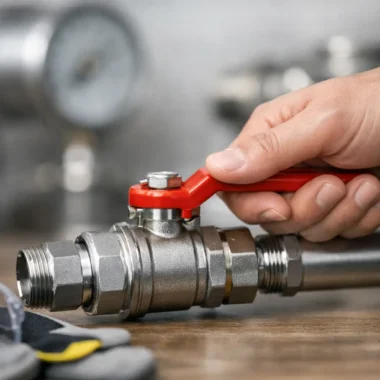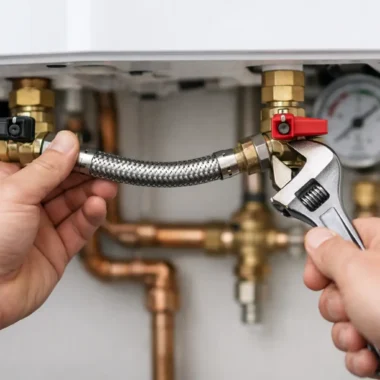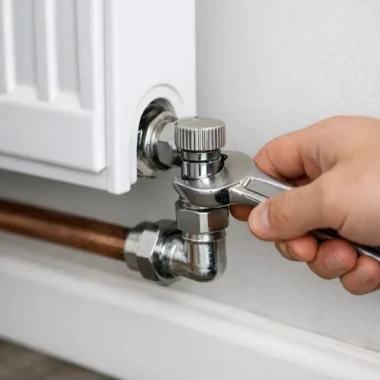
A leaking service valve under a kitchen sink is not the place to discover that the fitting chosen was wrong for the pipe, location or future access. The push fit vs compression joints decision comes up on routine repairs, first-fix work and appliance connections alike. Both joint types are well established in UK plumbing, but they seal in different ways and suit different working conditions.
Push-fit fittings save time where pipe preparation and access are good. Compression fittings offer a mechanical connection that many installers favour for visible pipework, valves and adaptable repairs. The right answer depends on pipe material, available space, temperature and pressure requirements, and whether the joint may need to be altered later.
How push-fit joints work
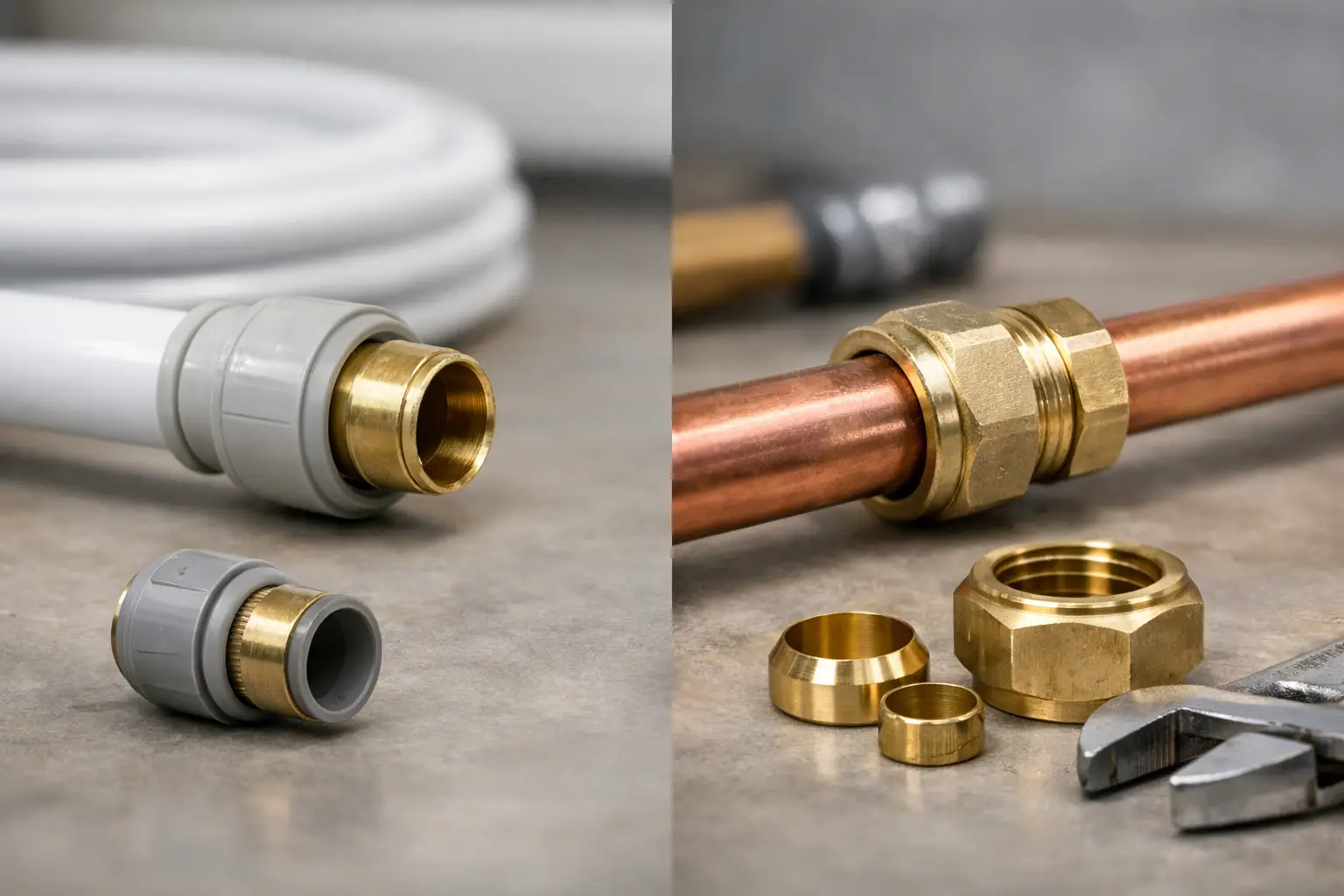
A push-fit fitting seals when fully prepared pipe is pushed through the fitting’s grab ring and O-ring to the internal stop. The grab ring holds the pipe against pull-out, while the O-ring provides the water seal. Many designs have a release collar, allowing the fitting to be demounted with the correct release action.
The main advantage is speed. There is no nut to tighten and no olive to compress, which is useful in awkward cupboards, behind sanitaryware or on maintenance calls where a fast, clean repair matters. Push-fit is also particularly common with plastic barrier pipe, provided the fitting and pipe system are compatible and the correct pipe insert is fitted.
That simplicity does not remove the need for preparation. A pipe end must be cut square, clean and free from burrs. Copper should be deburred so a sharp edge does not damage the O-ring during insertion. Plastic pipe needs a suitable insert or liner as specified by the fitting manufacturer, and the insertion depth should be marked before assembly. If the pipe has not reached the internal stop, the connection may look complete while failing to seal or grip correctly.
Some push-fit fittings accept both copper and plastic pipe, but this must never be assumed. Check the stated pipe diameter, material compatibility and approved applications. A fitting intended for potable water may have different limits from one designed for central-heating work.
Where push-fit earns its place
Push-fit is often the practical choice for domestic water and heating alterations using 15 mm or 22 mm pipe. It can reduce installation time on longer runs, make alterations easier and avoid the need for hot works. For competent DIY users, it also removes one common source of error: over-tightening a compression nut.
It is less attractive where pipework is exposed and a traditional all-metal finish is preferred. Fitting bodies can also be bulkier than compact compression connections, which matters in tight voids. In any concealed installation, follow the fitting manufacturer’s guidance on accessibility, pipe support and the specific application. Do not assume that a demountable fitting is automatically suitable to bury behind a finished wall or floor.
How compression joints work
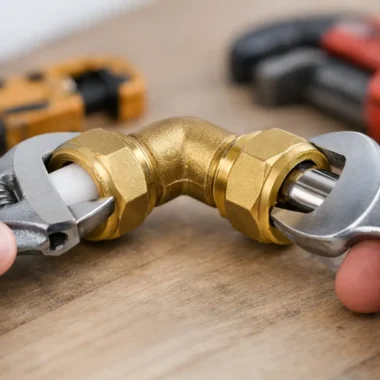
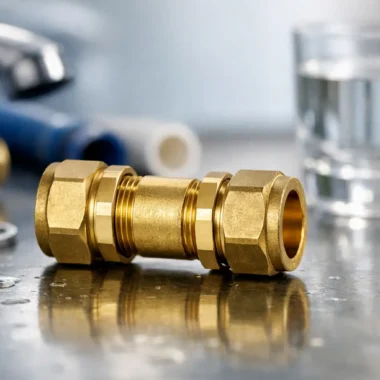
A compression fitting uses a nut and olive to form its seal. Tightening the nut compresses the olive onto the pipe and into the fitting body. The result is a durable mechanical connection used across copper plumbing and heating pipework, including connections to valves, taps, pumps and appliance valves.
Compression fittings are available in a wide range of forms: straight couplers, elbows, tees, reducing fittings, adaptors and service valves. Their broad availability and familiar installation method make them a dependable option for repair work, especially where an existing copper run has to be retained.
The connection takes longer than push-fit because each nut must be tightened correctly. Too little tightening can leave a weep. Too much can distort the olive, damage threads or make later disassembly difficult. Start the nut by hand to avoid cross-threading, hold the fitting body with a second spanner and tighten in controlled increments. Once the system is filled and tested, a minor adjustment may be enough for a small weep. Repeatedly tightening without checking alignment is not a repair method.
Compression fittings and plastic pipe
Compression joints can be used with certain plastic plumbing pipe, but only when the pipe and fitting manufacturers allow it. The correct insert is normally essential to support the pipe wall. A pipe stiffener from one system is not automatically suitable for another, so match the insert to the pipe type and size.
Plastic pipe also requires proper clipping. It expands more than copper as temperature changes, particularly on heating runs. A compression connection should not be used to force misaligned pipe into position or take the strain of an unsupported run. Support the pipe, allow for movement and keep the joint accessible where practical.
Push fit vs compression joints: the practical differences
The choice is rarely about one fitting being universally better. It is about fitting the joint to the job.
For speed, push-fit usually wins. A square cut, correct insert and full insertion can make a reliable connection in seconds. This is valuable when working in a cramped cupboard, replacing a short damaged section or assembling a plastic pipe run. It also avoids the need to turn a compression nut where there is little room for a spanner.
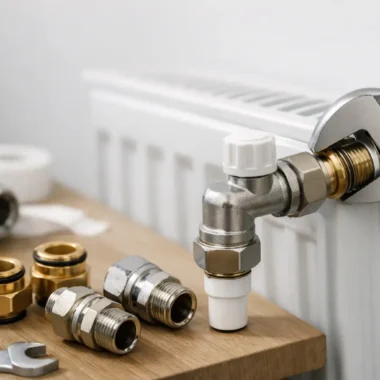
For a compact, traditional connection on copper, compression is often preferred. It works well close to isolation valves, radiator valves, tap tails and other threaded brass components. The installer can also orientate the fitting before final tightening, which is useful when matching existing pipework.
For future alterations, both have advantages. A demountable push-fit fitting can be released if the pipe end remains in good condition and the correct method is used. A compression joint can be dismantled, but the olive may stay fixed to the pipe and need removing or replacing. On an older installation, that can mean cutting back the pipe and allowing for the lost length.
For appearance, compression generally suits exposed copper installations better. For hidden or difficult-to-reach repairs, push-fit can be quicker, but access and manufacturer instructions remain decisive. Neither type should be selected purely because it is what happens to be in the van.
Checks before fitting either joint
Start by confirming the pipe outside diameter rather than relying on a visual estimate. UK domestic pipe is commonly 15 mm or 22 mm, but imperial copper and other sizes are still encountered on older properties. Use the correct adaptor where required rather than trying to make an incompatible fitting work.
Check that the fitting is rated for the system. Consider whether it is for hot and cold water, central heating, potable water or another application. Where drinking-water supply is involved, suitable approvals such as WRAS approval may be relevant to the product and installation. Do not use water fittings on gas work unless they are specifically designed, tested and marked for that purpose.
Pipe condition matters as much as fitting choice. Corroded, scored, painted or oval copper may not provide a dependable sealing surface. Cut back to sound pipe where possible. With plastic pipe, avoid crushed ends, confirm the pipe is round and use the specified insert. On both materials, keep the pipe straight as it enters the fitting and make sure it is properly supported.
Pressure-test the work before closing up. Inspect every joint while the system is under normal operating conditions, including after a heating system reaches temperature. A dry tissue around a suspected joint will often show a fine weep more clearly than a quick visual check.
Common mistakes that cause callbacks
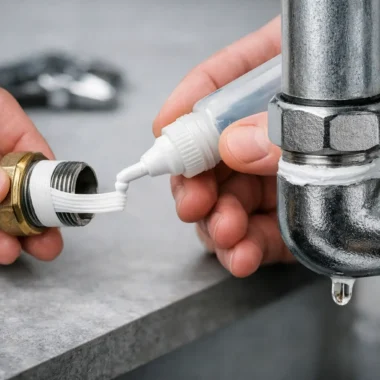
Most push-fit failures trace back to poor pipe preparation: an un-deburred copper edge, missing insert, incomplete insertion or incompatible pipe. Most compression failures come from damaged pipe, an olive that has not seated squarely, cross-threaded nuts or excessive tightening. Neither joint benefits from PTFE tape on the compression threads, because the seal is made at the olive, not the thread.
Avoid mixing components casually across brands and systems. Similar-looking 15 mm fittings can have different requirements for inserts, demounting and approved use. Where a job has existing pipework from a known system, using compatible parts removes unnecessary uncertainty.
For trade work, it is worth carrying both options. A compression coupler may be the best answer when repairing exposed copper beside a valve. A push-fit coupler may save valuable time when joining barrier pipe in a tight service void. Having the correct pipe cutters, deburring tool, inserts and spanners matters just as much as the fitting itself.
Choose the joint that gives a clean pipe entry, a rated connection and a realistic route for future maintenance. That approach prevents the small fitting choice from becoming the reason a straightforward plumbing job takes another visit.