
A condensate pipe that freezes on a cold morning can shut down an otherwise sound condensing boiler. That is why boiler condensate pipe regulations are not simply a finishing detail: the route, fall, material and termination point all affect whether the installation will drain reliably through winter.
For installers, the practical objective is straightforward. Route condensate internally wherever possible, connect it to a suitable foul-water discharge point, maintain a continuous fall and avoid exposed external pipework. The exact arrangement must also follow the boiler manufacturer’s installation instructions, which take precedence where they specify a particular connection, pipe size or termination method.
What governs boiler condensate pipe regulations?
In England and Wales, condensate drainage is considered within the wider Building Regulations requirements for sanitary pipework and drainage, particularly Approved Document H. Boiler installation standards, including BS 6798, and the appliance manufacturer’s instructions provide the detail that engineers use on site.
The legal position and guidance can vary between England, Wales, Scotland and Northern Ireland. If the work forms part of a boiler installation, replacement or alteration, check the requirements that apply in the relevant nation and the notification route for the job. Gas work on domestic boilers in Great Britain must be undertaken by a Gas Safe registered engineer where registration is required.
There is a useful distinction to make. Building Regulations set the outcome expected from the drainage arrangement, while BS 6798 and manufacturer instructions set out recognised installation practice. A pipework route may look neat, but it is not a good installation if it creates a freezing risk, lacks fall or discharges to an unsuitable point.
The preferred condensate discharge route
An internal gravity connection to the household foul drainage system is normally the best option. This might be a connection to an internal soil stack, a branch waste pipe or a suitable internal waste system. Keeping the pipe inside the heated envelope of the building greatly reduces the chance of ice forming in the line.
The connection needs to be made so that foul air cannot pass back into the appliance and the existing drainage system continues to work correctly. The boiler itself will generally have an internal condensate trap, but the full arrangement still needs to comply with the appliance instructions and drainage guidance. Do not assume that any convenient waste pipe is suitable without considering trap position, access and the risk of blockage.
A connection to a rainwater downpipe is not an acceptable shortcut. Surface-water drainage is not intended to receive boiler condensate, and older properties may have separate drainage systems. Likewise, avoid discharging across paths, patios or walls where condensate can create staining, icing or nuisance.
Where an internal route is genuinely impractical, an external run may be used, but it needs more care. External pipe is the part most likely to cause a winter breakdown, particularly where a short internal connection has been replaced with a long, poorly insulated route around the outside of a property.
Soakaways and external terminations
A purpose-made condensate soakaway can be an option where connection to a foul drain is not possible. It should be installed in line with the boiler manufacturer’s instructions and current drainage guidance, using a suitable permeable fill and positioned away from the building and other services.
This is not a universal solution. Ground conditions, the available space and the likelihood of the soakaway becoming saturated all matter. A soakaway on heavy clay, or one installed in a location that is difficult to inspect and maintain, may be less dependable than revisiting the internal drainage route.
Pipe size, material and fall
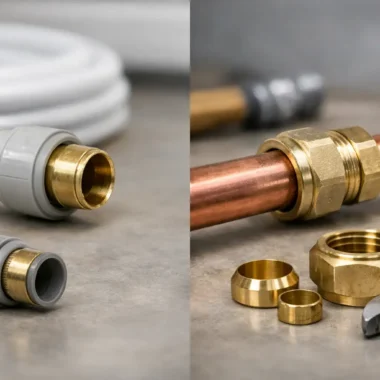
Condensate is mildly acidic, so plastic pipework is normally used. Solvent-weld waste pipe and fittings are commonly specified for external sections because they provide secure, sealed joints. Use compatible components throughout rather than mixing systems that do not make a proper joint.
For a short internal run, 21.5 mm or 22 mm plastic waste pipe is commonly used where permitted by the boiler instructions. Once pipework runs externally, a larger bore is generally required, with 32 mm plastic pipe commonly used as the minimum. The larger size gives more tolerance against freezing and allows condensate to drain when temperatures are low.
Falls are equally important. Condensate must flow continuously to the discharge point, with no backfall, bellies or unnecessary offsets where water can sit. Installation guidance commonly calls for a minimum fall of around 45 mm per metre on internal pipework, with a steeper fall used for external runs. Always confirm the manufacturer’s stated requirement before setting out the route.
Support pipework at sensible intervals with suitable clips. Sagging pipework can quickly lose its fall, especially where a long run is supported by only a few clips. Keep joints accessible where possible, and do not bury a connection behind boxing or finishes until it has been checked for leaks and flow.
Freeze protection for external condensate pipework
If an external route cannot be avoided, minimise the exposed length first. Insulation helps, but it should not be used to justify an unnecessarily long external run. The pipe should leave the building as close as possible to the discharge point, then follow the shortest practical route with a continuous fall.
Use insulation suitable for external conditions and protect it from damage and water ingress. Standard indoor pipe lagging can deteriorate quickly outdoors. On difficult routes, trace heating may be specified, but it must be installed correctly, suitably controlled and permitted by the appliance manufacturer. It is a solution for a genuine constraint, not a substitute for sensible routing.
Pay particular attention to the boiler connection, elbows, low points and the final outlet. These are common locations for freezing because flow slows down or a small amount of water remains after the boiler has stopped running. Avoid reducing the pipe diameter, sharp restrictions and uninsulated fittings on the exposed section.
Common installation faults to avoid
The most frequent problem is a condensate line that has been treated like an overflow pipe rather than a drainage pipe. It may have too little fall, an undersized external section or a termination chosen solely because it was easy to reach.
Other faults include connecting into a rainwater pipe, leaving external joints unsealed, using unsuitable pipe material, routing the pipe where it can be damaged, and failing to protect it from frost. A condensate pipe should also be considered alongside the flue route, service access and future maintenance. A connection that can only be inspected by removing kitchen units or external cladding will cost time later.
Before commissioning, check that condensate flows freely from the boiler to the chosen termination. Inspect every visible joint, confirm the pipe is adequately supported and make sure the route has not been altered by later trades. If the boiler displays a condensate-related fault during cold weather, inspect the external run before assuming there is an appliance fault.
A practical check before ordering materials
For most jobs, establish the route before selecting fittings. Measure the internal and external lengths, identify the available foul-water connection, confirm the required pipe diameter in the boiler manual and allow for clips, bends, adaptors, insulation and any access points needed for maintenance.
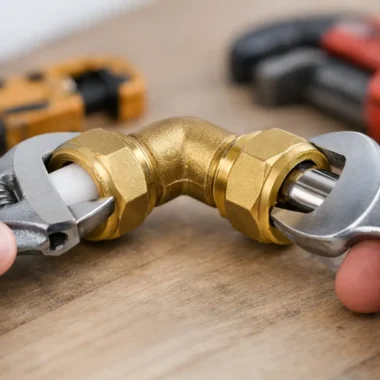
Where the route transitions from the boiler’s outlet size to a larger external pipe, use the correct adaptor and keep the change straightforward. A small number of well-planned fittings is usually more reliable than a route made up of several tight bends and improvised reducers.
For trade work, it is worth carrying the common condensate sizes, solvent-weld fittings, pipe clips and external-grade insulation as standard stock. It prevents a minor drainage detail holding up a boiler commission or a return visit. Mepstock supplies the pipe connections and fittings needed to build out a properly sized, secure condensate route.
The best condensate installation is usually the least dramatic one: a short internal run, a suitable foul connection, correct fall and enough access to inspect it. Plan that route before the boiler is fixed in place, and a common winter call-out becomes far less likely.