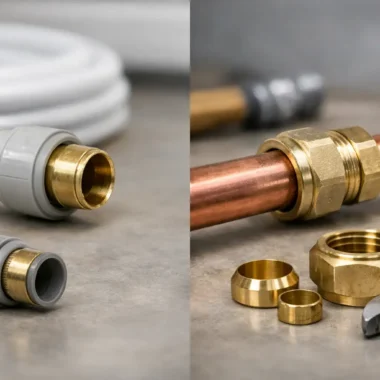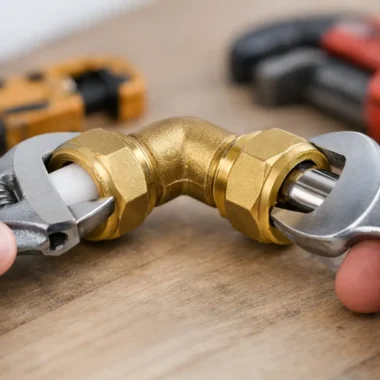
Order the wrong endfeed elbow at 4pm and the whole job can stall for something that should have been simple. This endfeed fittings sizes guide is built to stop that happening – whether you are stocking van essentials, pricing a bathroom refit, or sorting a one-off repair on existing copper pipework.
Endfeed fittings are straightforward in principle. They are solder ring-free copper fittings designed to be used with soldered capillary joints, and they are sized to match the outside diameter of copper tube. Where people get caught out is not the fitting type itself, but the sizing, the old pipe on site, and the difference between what should fit in theory and what actually fits once you cut back and clean the pipe.
Endfeed fittings sizes guide for UK pipework
In UK plumbing, the most common endfeed fitting sizes are 10mm, 15mm, 22mm and 28mm. On larger commercial or plant applications you will also see 35mm, 42mm and 54mm, but for most domestic heating and plumbing work, 15mm and 22mm do the heavy lifting.
The key point is simple: endfeed fittings are matched to the nominal copper tube size they are made for. A 15mm endfeed coupling is designed for 15mm copper pipe. A 22mm endfeed tee is designed for 22mm copper pipe on all equal outlets unless it is listed as a reducing tee.
That sounds obvious, but it matters because tradespeople and DIY buyers sometimes describe pipe by application rather than by measured size. Someone may say they need a fitting for a basin feed, a boiler connection or an old central heating branch, but that does not tell you the actual pipe size. The fitting still has to match the tube diameter.
Common domestic sizes and where they are used
10mm is usually found on microbore heating systems. It is common on radiator runs in some existing installations, especially in older or budget-driven heating layouts where reduced water volume was part of the design.
15mm is the standard domestic workhorse. You will see it on hot and cold water services, tap feeds, toilet supplies, shower feeds, radiator tails and general branch pipework.
22mm is commonly used where higher flow is needed. Typical examples include incoming supplies after the stop valve, vent and cold feed arrangements, larger hot water distribution, and primary heating circuits close to the boiler or cylinder.
28mm and above are more likely on larger dwellings, commercial jobs, plant rooms and older gravity systems where flow rates or pipe runs justify the larger bore.
How endfeed fitting sizes actually work
An endfeed fitting accepts copper tube into a socket. Once the pipe is cut square, deburred, cleaned and fluxed, the joint is heated and solder is drawn into the capillary gap. The fitting size refers to the pipe it accepts, not the fitting body measurement.
That means you should not try to measure the outside of the fitting and work backwards. If you are identifying an unknown fitting from stores stock or from a site box, check the pipe it is intended for or look for the stamped size marking where available.
This also explains why old assumptions can cause ordering mistakes. A 15mm fitting is not roughly 15mm across in every visible dimension. The internal socket is engineered to suit 15mm copper tube with the correct capillary tolerance for soldering.
Equal, reducing and threaded combinations
Not every endfeed fitting is equal-size throughout. Alongside standard elbows, couplings and tees, you will find reducing couplings and reducing tees such as 22mm x 15mm or 28mm x 22mm. These are used where the pipe size changes without adding unnecessary extra fittings.
There are also endfeed to threaded transition fittings. These are useful where part of the system remains copper soldered pipework but the connection point is a valve, appliance, cylinder or brass component with male or female threads. In those cases, both the pipe size and the thread size have to be right. Getting one side correct is only half the job.
Measuring pipe properly before you order
If the pipe is exposed and accessible, measure the outside diameter of the copper tube, not the bore. A vernier caliper is the cleanest option, but on site a decent tape measure or size guide can be enough if the pipe is not painted thickly or distorted.
On existing installations, paint, corrosion and poor access can make quick checks unreliable. If there is any doubt, cut back to a clean section before you commit to the fitting size. This is especially relevant on repair work where old solder residue, dents or slight ovality can make a pipe look like the wrong size when the issue is really the condition of the end.
For anyone dealing with older systems, remember that modern endfeed fittings are intended for standard metric copper tube. Most UK domestic systems you are likely to work on will still align with the common modern sizes, but older or altered systems deserve a second look before you fill the basket.
Common mistakes this endfeed fittings sizes guide can help you avoid
The first mistake is confusing pipe application with pipe size. A radiator branch is not automatically 10mm or 15mm, and a mains feed is not automatically 22mm. Check it.
The second is mixing fitting systems without thinking through compatibility. Endfeed, compression, push-fit and press systems can all appear in the same installation, but each connection type has its own requirements. There is nothing wrong with mixing systems where it makes sense, but you still need the correct size and transition points.
The third is overlooking reducing fittings. On many jobs, the neatest answer is not an equal tee plus a reducer. It is a proper reducing tee in the right size combination. Fewer joints usually means less installation time and fewer potential leak points.
The fourth is assuming old pipe will accept a new fitting just because the nominal size is correct. If the pipe is scored, out of round, heavily oxidised or still loaded with old solder, the problem is pipe preparation rather than the fitting.
Choosing the right endfeed fitting for the job
Size is only one part of the decision. You also need the correct fitting form – elbow, tee, coupling, reducer, stop end or adaptor – and the right material specification for the application. On potable water systems, approval and suitability matter. On heating work, temperature and installation method matter. On visible pipework, the neatness of the finished joint may matter just as much as speed.
Endfeed fittings remain popular because they are compact, reliable and cost-effective. They also suit areas where a bulky compression body is awkward or where you want a cleaner finish. The trade-off is that they rely on proper soldering practice. If the pipe is not cleaned, fluxed and heated correctly, the fact that the size matches will not rescue the joint.
That is why competent installers still treat sizing and preparation as one decision, not two separate ones. A correctly sized fitting on badly prepared tube is still a bad joint.
When reducing sizes makes sense
Reducing from 22mm to 15mm is common where a larger distribution line feeds smaller branches. Reducing from 15mm to 10mm is common on microbore heating legs. The main thing is to reduce where the design needs it, not simply where stock happens to be available.
Oversizing wastes space and can complicate routing. Undersizing can restrict flow and affect system performance. On hot and cold water services that may show up as poor delivery at outlets. On heating, it can affect balancing, warm-up times and overall circuit behaviour.
Stocking the sizes you use most
For regular domestic work, a practical van stock usually centres on 15mm and 22mm endfeed fittings, with selected 10mm items if you deal with microbore systems. Couplings, equal tees, elbows, stop ends and a handful of common reducers cover a large share of routine work.
For merchants and online buyers, the advantage of a specialist supplier is speed of identification. Clear product naming matters here. When the listing shows the fitting type, material and exact size combination up front, it cuts ordering errors and gets the right part to site faster. That is the sort of practical detail trade buyers expect from suppliers such as Mepstock.
Endfeed fittings sizes guide for repairs and upgrades
Repair work is where sizing issues show up most often. New-build or full first-fix jobs are usually planned around known materials and pipe sizes. On repair and maintenance work, you are dealing with what is already in the building, and that means previous alterations, mixed systems and occasional surprises.
If you are tying into existing copper, inspect more than the visible section. Check whether the line steps down nearby, whether a previous installer has used a reducer out of sight, and whether the fitting you are replacing was actually the right size to begin with. It is not unusual to find a badly forced repair that has created confusion for the next person.
Where there is uncertainty, take the extra minute to confirm the pipe OD and fitting type before ordering. That small check is cheaper than return trips, drained-down systems and wasted time on site.
Endfeed fittings are not complicated, but they are exact. Match the fitting to the copper tube size, choose the right fitting pattern, and do not let assumptions about the system talk you out of measuring properly. If a job depends on one small fitting arriving right first time, accuracy is what keeps it moving.